 IAS on Facebook IAS on Facebook
 IAS on Instagram IAS on Instagram

|

|
 |
|
|
|
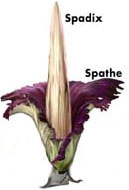
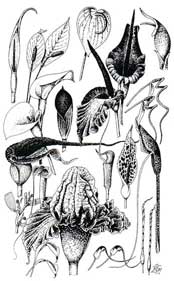
Aroid is the common name for members of the Araceae family of plants, sometimes known as the Philodendron or Arum family. The sometimes beautiful and sometimes bizarre combination of spathe and spadix known as the inflorescence, and sometimes referred to as a "flower", is a distinguishing feature of all aroids. The densely flowered spadix is subtended by a spathe, a modified leaf that protects the spadix and is often important in pollination. The flowers on the spadix are pollinated by flies and beetles that are attracted by the sometimes foul scents, or by bees attracted by sweet scents. Heat occasionally plays a role in pollination. That is, the spadix increases in temperature to volatilize scents which in turn attract insects. Skunk cabbage, Symplocarpus foetidus, which may even melt its way through snow, is known for heat production in its spadix. The varying colors of the spathe and the spadix may also play an important role in pollination.
|
|
 |
|
|
The
spathe and the spadix of
Amorphophallus titanum by Kandis Elliot,
Department of Botany, University of Wisconsin.
|
|
|
|
|
|
|
|
|
|
|
 |
|
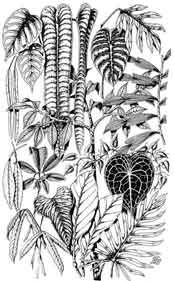
Aroid
Foliage by David Leigh. Click
on the image for more information.
|
|
|
|
|
|
|
|
|
|
The intellectual allure of aroids is matched by their aesthetic qualities. No other group of plants can compare to the extravagant and exotic foliage exhibited by Araceae. Leaf blades are wide ranging in size, shape, and color and sometimes vary even from immature to mature stages. They range in size from small as a coin to as large as several meters in width as is the case in Amorphophallus titanum, considered a giant in the aroid world. Leaf blades may be variously lobed or divided, and in some groups window-like holes may occur naturally in the leaves. Texture of foliage varies as well, from leather-like, as in Philodendron rugosum, to velvety, as in Anthurium warocqueanum, to silky, as in Xanthosoma pubescens. "Diversity" probably best describes the characteristics that reside within this family of plants.
|
|
|
Araceae remains one of the most poorly known families of plants to science with large percentages still new. There are 104 genera and about 3700 species if the Lemnaceae (the duckweed family) is not regarded as a generic synonym, or 108 genera and about 3750 species if the Lemnaceae are included. More aroids are tropical than not and include members from terrestrial, aquatic, and epiphytic habitats. But there are many aroids which thrive in the colder northern climates and indeed require the cold to successfully pass the through their regular periods of dormancy, and only a few of the genera from the Americas occur also in the Old World. Asia has more genera than America, but America has more species, with well over half of all the species in the world.
|
|
 |
|
|
Aroid
Inflorescences by David Leigh. Click
on the image for more information.
|
|
|
|
|
|
|
|
|
|
The
mission of the International
Aroid Society is to provide information, assist in the
distribution of unusual species and provide fellowship to
everyone with an appreciation for this wonderful plant family.
|
|
 |
|
|
|
Please join the International Aroid Society today!
|
|
|
|
|
|
|
|
|
|
|
|

